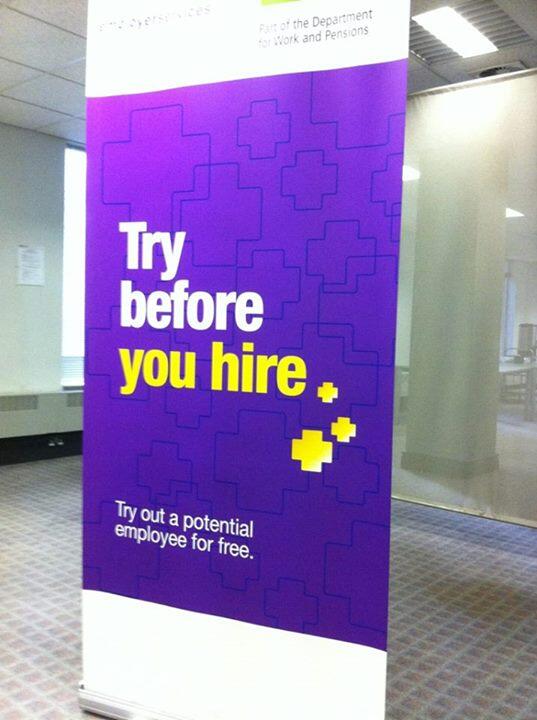
People as possessions. Not even possessions. Things to be used. Passed around. Changed if not quite right instead of invested in.
Free trial. Won’t cost a penny. It should cost company to employ someone, that person then has at least some value. If it costs to employ then an employer has more reason to get the recruitment process right.
There is already a way for employers to ‘try before your hire’. (Someone at the DWP got a massive slap on the back for that one.) It’s called Temp-to-Permanent. Someone is employed through an employment agency on a temporary basis. If after three to six months everyone is happy, the employee is transferred from the employment of the agency and becomes a full member of the client company’s staff, subject to another six months probation and 2 years of being able to be given the sack for no reason hanging over them.
Why should a company get a free input, especially when it’s someones’ labour? Especially when it’s a company that doesn’t need help paying the bills? People reduced to serving the interests of corporations, rather than the other way round.
The State, whoever running it, is not running it for us, the people. They’re running it for their mates in the board room.
Giving a speech at the London Chamber of Commerce, Engskov said: “I am announcing changes which will results in Starbucks paying higher corporation tax in the UK – above what is currently required by law.
“Specifically, in 2013 and 2014 Starbucks will not claim tax deductions for royalties or payments related to our intercompany charges.
“In addition, we are making a commitment that we will propose to pay a significant amount of corporation tax during 2013 and 2014 regardless of whether our company is profitable during these years.
Paying corporation tax when when you don’t make a profit is not paying corporation tax – it’s a gift. We don’t want Starbucks’ fucking charity, the wanker. We just expect them to pay the right amount of tax that is due.
FREQUENTLY ASKED QUESTIONS (FAQS) ON THE
APPLICATION OF EU ANTITRUST RULES IN THE MOTOR
VEHICLE SECTOR
27 August 2012
Since the adoption of the new motor vehicle Block Exemption Regulation1 and the
Supplementary Guidelines2, the Commission’s services have received a number of
questions relating to the application of the new framework for motor vehicle distribution
and repair and for the distribution of spare parts for motor vehicles. Where these
questions have been frequently asked, or are otherwise likely to be of wider interest, they
are reproduced below together with answers and explanations.
Some handy questions and answers regarding who can do what, with what, with regards to supplying parts and servicing your vehicle, especially when it’s still under warranty.
Free banking is “a dangerous myth”, according a top Bank of England official.
The comments come from Andrew Bailey, who is due to become the chief regulator of the financial services industry in July.
He says customers may think their account is free, but the true costs are actually hidden.
Those hidden costs would include the extremely low interest rate that many banks offer on current accounts.
Due to the nature of a current account, it should be free. A current account is not for saving, it’s not an investment, it isn’t money for taking risks with. It is an account for doing daily business with.
So much of our daily financial transactions are electronic that without a current account you’re practically outside society without one. It is one of those things that, without one, so many things are shut off.
Businesses and banks, for decades have been pushing people to get accounts. How many people get paid in cash, in an envelope at the end of the week or month? Not a part jobs, in pubs or whatever, but proper 40 hour a week jobs? I couldn’t get paid in cash even if I wanted to, and practically nobody else could either. So if I’m not allowed to be paid in cash, why should I have to pay a bank to be able to receive my wages?
If I overdraw, fair enough, I should have to pay a penalty. The cost should be may seem high, £25 for a computer generated letter telling me I have no money may feel rather insulting, but then I can do several things: Sort myself out so I don’t overdraw; get an agreed overdraft which would cost a lot less or; move to a bank that charges less for a letter. To be charged for being able to access and manage my money when I have no choice, that is the real insult.
“In short, I think that the reform of retail banking in this country cannot move ahead unless we tackle the issue of free in-credit banking, and have a much better sense of what we are paying for and how we are paying,” Mr Bailey said in a speech.
You want me to have the account. As long as I’m only using my money, you take the cost of it.
He said the situation also made it difficult for banks to understand the cost of the services they provide, which may have contributed to the mis-selling of financial products.
Between them, Barclays, Lloyds, Royal Bank of Scotland and HSBC are currently paying about £9bn in compensation for mis-selling loan insurance.
“I worry also that this unclear picture may have encouraged the mis-selling of products that is now causing so much trouble,” Mr Bailey said.
It’s difficult for the provider of a virtually madatory service to understand it’s cost? Aw, diddums. Is there anything these fucking wankers do understand? Most of them cunts in The City don’t understand half of the products they trade. Selling debt and other stuff in ways that are so fucking difficult to understand they didn’t realise how fucked the whole system is until it all came crashing down on top of them, and us.
If you don’t understand what you’re doing, you’re doing it wrong.
And it may have contributed to mis-selling? I don’t buy that for a fucking second. The mis-selling happened because they wanted to make money and to tell everyone they needed loan insurance was the easiest and quickest way they could make money. If they did it deliberately, they thought they could get away with it. If they didn’t do it deliberately, they obviously didn’t know what they were doing and shouldn’t have been doing it. Either way they were being cuntish. Fuck ’em.
However, Mr Bailey says it is a difficult situation for banks because the first one to start charging for accounts could lose significant amounts of business.
Speaking on the BBC’s Today programme, BBC Business Editor Robert Peston said: “He’s saying you can’t leave it to the banks to clean-up their act in this way.”
We’ve learnt over the last few years that the banks can’t be left alone to do pretty much anything.
“That’s why he is saying – which I think is really pretty significant because this chap is replacing Hector Sands as the senior regulator in the City of London – that either the regulators or the government actually have to intervene to end the myth of free banking.”
Charge me for having a savings account, ISA’s, being overdrawn or whatever, but start charging for current accounts, the banks can get to fuck.
Something about this Big Society Capital or Bank (or what ever it’s called) doesn’t sit quite right with me. It’s not so much the idea itself, more of where the money is coming from.
The money to pay for all these social enterprises is going to come from dormant bank accounts. Accounts that have been seen no activity for 15 years. That’s the bit that feels a little wrong. Raiding bank accounts, albeit ones that haven’t been touched for a while.
Instead of dormant bank accounts what about Bona Vacantia?
“Bona Vacantia” literally means vacant goods and is the legal name for ownerless property that passes to the Crown. We administer the estates of persons who die intestate without known kin and collect the assets of dissolved companies and failed trusts.
The person leaving the assets is definately dead. There is a proliferation of companies tracking down possible inheritors (ata a price, obviously) and so the realistic timescale for putting those ownerless assets to good use could be dropped to ten years for a start.
Using unclaimed inheritence doesn’t feel like such a grab at private money. It seems a more civilised way to use money that has nowhere else to go.
Oh yes, that famous phrase Bob Geldof, may or may not have, shouted at all of us in the rich western world during Live Aid. The original one, not the shitty (shittier?) sequel.
Anyway, whether St Bob said those actual words or not, that is what he’s wanted us to do ever since. Now, though, he’s shouting at the very people he was wanting to give all that money to 30-odd years ago.
[Geldof] is now the chairman of an Africa-focused private equity fund which said earlier this month it had raised $200 million from investors, close to half its targeted size of $450 million.
Dubbed 8 Miles, the fund plans to invest in companies that can develop into “African champions” in sectors such as agribusiness, telecoms and consumer goods.
“We put together our little thing – a goldilocks thing, not too small, not too big, just right. And we will make a lot of money, a lot. For me I want to leave behind me firms, farms, factories. Fuck the money, that’s me,” Geldof said.
Geldof’s fund is promising a rate of return of 25% – or, in other words, is promising to take a large chunk of any wealth created straight back out of the continent into the developed world.
But remember, Geldof’s not really bothered about the money:
Geldof referenced the big payday of some of private equity’s titans, including Henry Kravis and George Roberts, who got $94 million each in 2011 from buyout firm KKR & Co LP , in also making a wider case for philanthropy.
“You have got the four houses, the three jets, the 10 cars, the 65th fucking Picasso. What’s the point? So its stuff, and right now it’s the stuff that will get us out of that mess,” Geldof said.
So, Geldof’s big idea is that you encourage people to invest in Africa, to rake enormous profits out the natural resources and endeavours of those who live there, on the sort-of-off-chance that the people who’ve made all that money will decide they don’t really need it and give some of it back?
Chances are pretty good you’ve recently seen the “Banksy on Advertising” quote that begins, “People are taking the piss out of you everyday.” The passage is from Banksy’s 2004 book Cut It Out, and it presents the idea that if advertisers are going to fill your world with ads, you have every right to “take, re-arrange and re-use” those images without permission. The quote has been posted widely on Facebook, Tumblr, and Twitter, which is where I found it.
Here’s the interesting part:
Most of it is swiped directly from an essay I wrote in 1999, in the “Death, Phones, Scissors” issue of my zine Crap Hound. The first paragraph is more or less original, but the rest is mine, right down to the same words and phrases.
…
It’s hard to know how to feel about this. My first thought was, “Hey, Banksy reads Crap Hound!” Then, “What the fuck is going on?” Then, “Am I a real person? Am I actually happening?” And finally, “Am I a beautiful flower angel sent from heaven to inspire Banksy?”
As problems go, it’s a pretty nice one to have. I like Banksy’s art and ideas. I’m flattered he liked my writing and my sentiments, and I’m happy others liked the quote enough to post and forward. I’ve seen forums where people are debating the passage, including rebuttals from ad-agency twats. It’s on wikiquotes and a hundred blogs. My essay never would have had that impact on its own.
The downside is that Banksy’s name is always on it. Seeing my writing credited to someone else makes it a little less magical. Same with knowing that one day (maybe soon, since the issue in question is being reprinted), I’ll get to hear how I ripped off Banksy.
Justine Greening, the Transport Secretary, has withdrawn plans to change MOTs from the current timings of the first MOT at three years and then annually thereafter, to four years and then bi-annually. This is A Good Thing.
The proposed reform was part of a Governmentwide drive to sweep away red tape in what was described as a “bonfire of regulations” aimed at stimulating business and economic growth.
I have no idea how reducing the amount of MOTs performed every year could be described as ‘reducing red tape’ to enable businesses to grow.
Obviously to perform this function on behalf of the government some requirements have to be met, somewhere secure to store the certificates, like the company safe, properly trained mechanics to perform the MOT itself and a bay with specific equipment required to carry out the MOT. The equipment can be fitted to an existing bay in the workshop that already has a vehicle lift or pit, and is something a good workshop will already have, and with proper maintenance will last for years. The mechanic with the paperwork to carry out MOTs does not get paid that much more than a mechanic without. The only real cost would be to send a mechanic a workshop already employs off to get his certificate. There really isn’t much ‘red tape’ at all.
In all my years of working professionally in vehicle workshops, not once has one been inspected by the ministry. Once the initial inspection has been done to grant the licence to carry out MOTs, garages are pretty much left to their own devices.
The only thing extending the period between MOTs would do is reduce the revenue from them, in terms of the actual MOT itself and also in the repair work that a failed MOT throws up, and that can’t really be considered helping businesses, can it?
The bigger issue though, is in vehicle safety. The MOT is an annual check to make sure the vehicle is roadworthy. For many people the MOT is the only time a car gets more than just the depth of tyre treads looked at.
Supporters of the change argued that cars were better built and more reliable than they were.
Cars may be better built and more reliable, but without proper maintenance, even a modern car can be dangerous. The cost of an MOT once a year, just under £60, is not a massive burden to a motorist and the twelve months period in between is a good time period. The test also has ‘advisory’ notices, not just pass or fail tick boxes. A ball joint is worn or some rust in the wrong place is getting serious but not serious enough to fail. This gets flagged to the owner as needing attention. The annual test puts a bit (just a bit) of impetus on the owner to get it fixed. A bi-annual test would reduce this even further.
In addition ministers were keen to be seen to be driver friendly by easing the financial burden at a time of soaring fuel prices.
Getting rid of a £60 cost once a year does nothing, except reduce the income of MOT test stations and increase the risk to everyone else from dangerous vehicles.
If ministers want to be seen to be doing something for the driver, then reducing the tax burden of fuel would be a good start, and not just not increasing the tax on it. A good example of getting rid of ‘red tape’ to the benefit of industry and customers are the new rules on block exemption…
The new rules introduce a 30% market share threshold above which agreements between car manufacturers and authorised repairers will no longer be block exempted, aligning the rules with the general framework (Vertical restraints block exemption Regulation 330/2010 adopted on 20 April, see IP/10/445 and MEMO/10/138). This will make it easier for the Commission to tackle possible abuses to the detriment of consumers, such as the refusal to grant independent repairers access to technical information. It will increase competition between authorised and independent repairers.
The new rules will strengthen repairers’ access to alternative spare parts which can represent a big share of the repair bills.
Car manufacturers will no longer be able to make the warranty conditional on having the oil changed or other car services only in authorised garages. Of course, manufacturers may request repairs covered by the warranty – and paid for by the manufacturer – be carried out within the authorised network.